
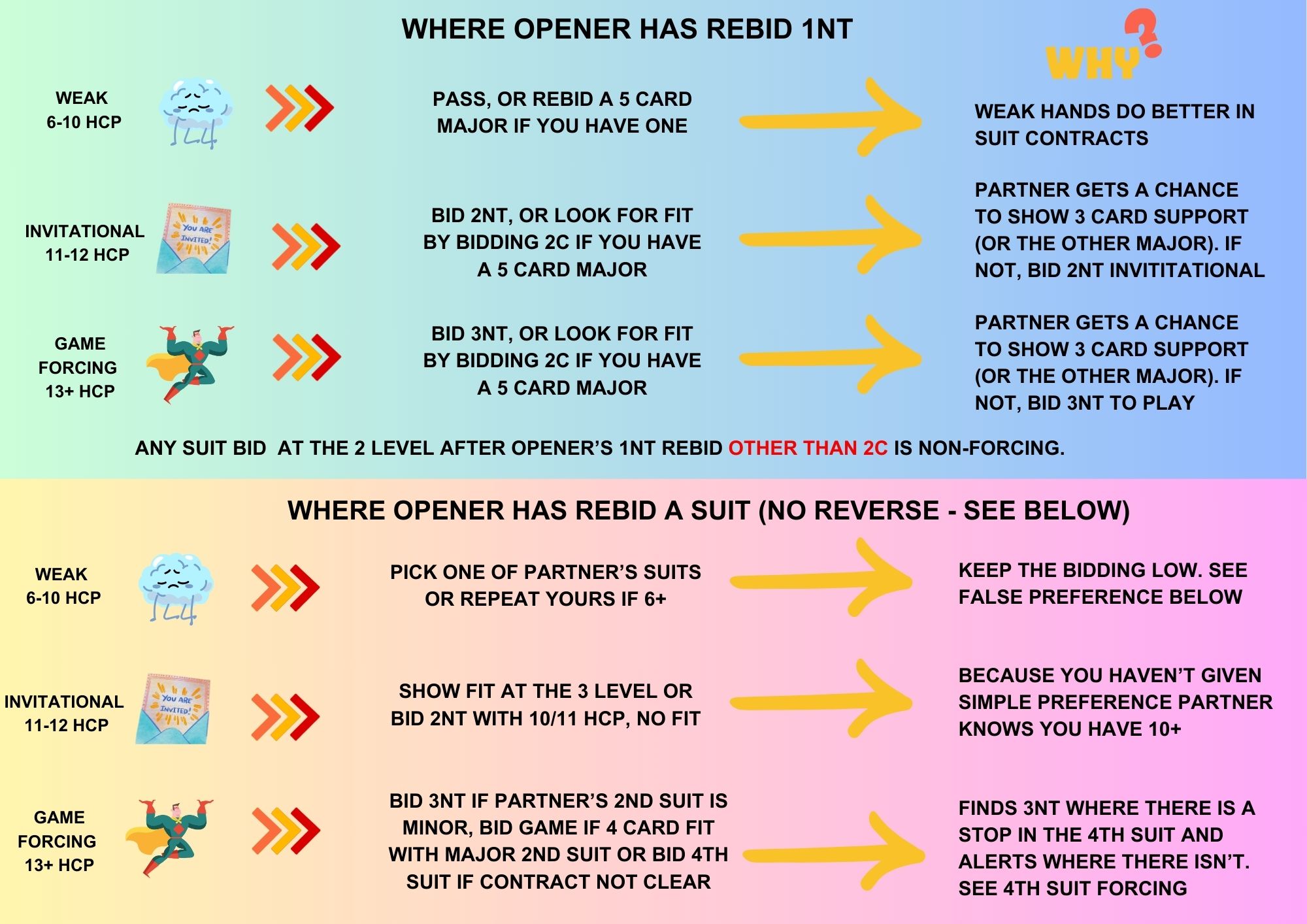
You can see from the panel above that when your partner has rebid NT and you have a balanced hand you can just raise to the appropriate level of NT (you can also bid 4NT as an invitation to slam or 6NT if you can see 33 points between you (you would need 21!). But when you have 5+ cards in a major suit, or four cards in the other major you can make an artificial bid of 2C to give partner a chance to show helpful holdings. See the section on Ceckback for more details.
When opener’s second bid is a suit, rather than NT, you know for sure that they have an unbalanced hand. If it’s unbalanced with just one long suit, they will have rebid that suit, showing 6+. If they have a second suit, they will have bid that, and should now have at least five cards in their first suit and at least four in their second.
So when they have shown two suits, you can assume they are 5-4 and decide whether you have fit. If they are 5-5 or 6-5 they will bid their second suit again next time. What you do next depends on how strong your hand is, as you will see from the panel above.
You will see that with weak hands you have to ‘pick a suit’ or give what we call simple preference, for one of opener’s suits (unless you have 6+ cards in your own suit in whoch case you just bid it again). Giving simple preference means bidding opener’s first suit at the lowest level if that’s your preference, or passing if their second suit is your preference. A new suit from opener at the 2 level is not a forcing bid unless it’s a reverse (see below).
There’s a funny thing about this preference decision, though, which is just based on what is most likely to work out best most of the time, and that is:
UNLESS YOU HAVE AT LEAST TWO MORE CARDS IN OPENER’S SECOND SUIT THAN IN THEIR FIRST, GIVE PREFERNCE FOR THE FIRST
This can be hard to make yourself do, especially if you have nicer cards in the second suit but you just have to trust the probabilities.
If your hand is invitational, you get a little more choice in the matter. You can show fit by bidding one of their suits (usually the second because you would often have shown fit with the first already if you had it) at the 3 level, or you can show a balanced hand that doesn’t have fit with either suit by bidding 2NT.
If you have a game forcing hand it’s really a question of thinking about which is likely to be the best game. If you have no fit with either of partner’s suits but you have good cards in the other two suits, then 3NT is probably your best game, so you can just bid it. If partner has shown spades and hearts, and you have four hearts, then you can just bid 4H.
Suppose, though, you don’t have fit with either of partner’s suits, you have good cards in your own suit but only small cards in the fourth suit. Now it’s not clear that 3NT will be a good contract because the opponents might be able to take a lot of tricks in that suit. Maybe you think your hand is too strong or too distributional to play in 3NT and you want to find out more about partner’s other four cards? You can use a handy artificial bid of the fourth suit. This is called fourth suit forcing and it allows your partner to:
- Show three cards in the suit you bid originally, if they have that
- Show a stop in the fourth suit by bidding NT in case you are worried about that suit
- generally give you extra information to help you decide on the best game contract.
The separate section on Fourth Suit Forcing will give you more information on this useful piece of system.
REVERSE BIDS
This is quite a tricky concept to grast at first and your best bet would be to watch the video about reverse bids and take the quiz to check that you understand.
If your partner has made a reverse bid, then you can’t give simple preference by passing their second bid, because it’s forcing. See the next section (After Strong Rebids) for more advice on what to do in this situation.