
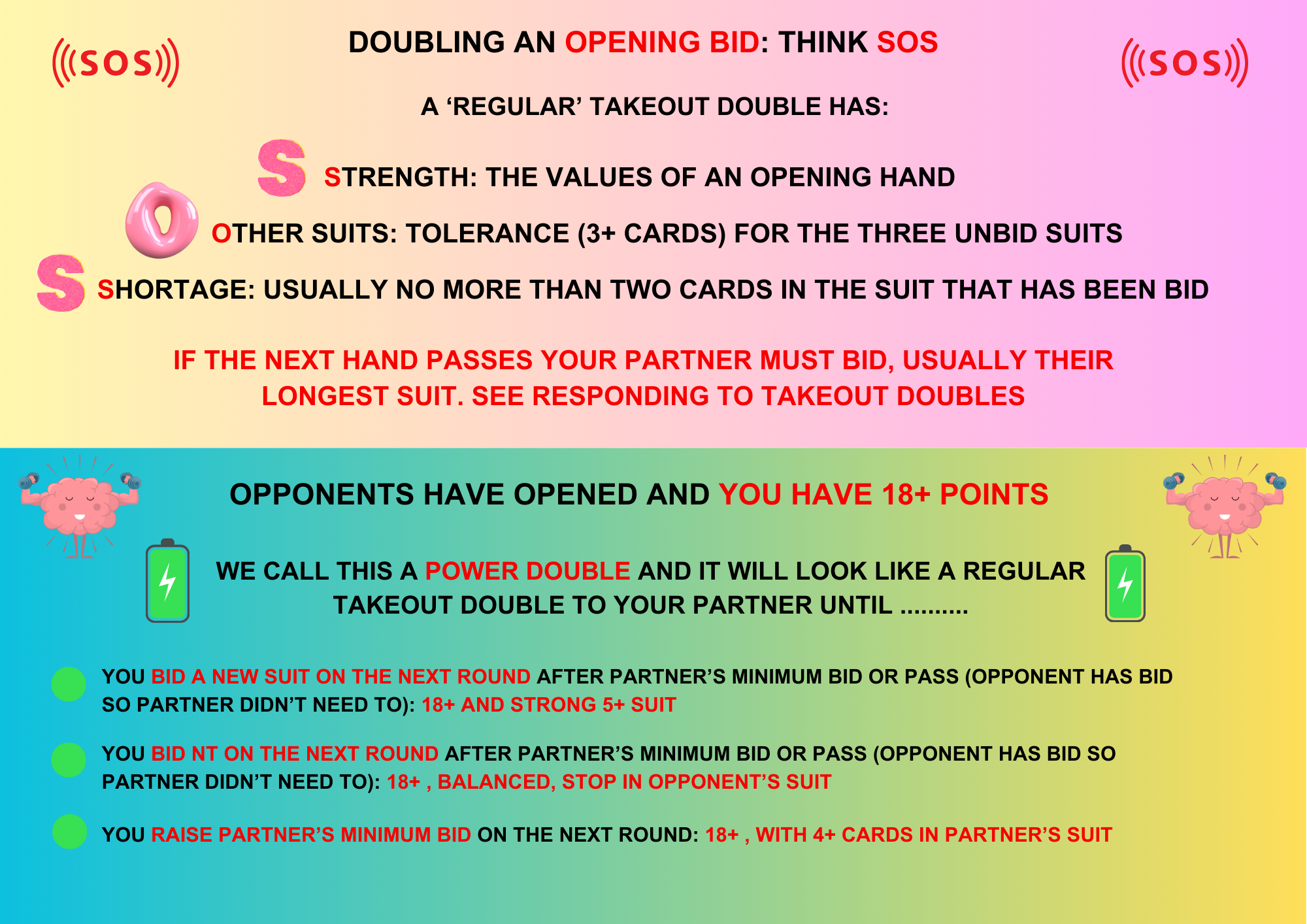
If you have read the section on overcalls, you’ll remember that you need five or more cards in any suit to overcall. But what if your opponents have opened the bidding and you have enough points to bid but you dont have a five card suit?
If you have 3+ cards in all of the suits other than the one your opponent has bid, you’d like to be able to ask their partner to pick their preferred one of those three suits. We use double in this situation to do just that. It’s a really useful bid.
This is what we call a ‘takeout double‘ – we want partner to take the opponents out of the contract they are currently in and put us in a contract instead. We also use double for penalties at higher levels of bidding, when we don’t think our opponents will make their contract and we gain more points if they fail. You’ll find some guidance as to how to tell which is which in the When is Double Penalty section but for now, just work on the basis that all doubles of part score contracts are intended as takeout, asking partner to bid.
If you double your opponents’ bid and your left hand opponent (LHO) passes, your partner can’t afford to pass because then your right hand opponent (RHO) would pass too, ending the auction, and they would get lots of extra points for making their measly part score. So your LHO passes, your partner is forced to bid, even if they have no points at all – they just have to bid their longest suit. If your LHO bids, they are no longer in a doubled contract, so now your partner can pass if they have a weak hand.
Let’s think for a minute about that first case, where your LHO passes and your partner is forced to bid. Now, if they always bid their chosen suit at the lowest available level you are not going to be able to tell whether partner is bidding because they are forced to, and have a very weak hand, or whether they actually have a hand that they would like to bid. For that reason, the partner of the doubler needs to jump a level in their chosen suit if they have between about 8 and 11 points to show a hand that wants to respond. Now the doubler can bid on, or not, depending on how strong their hand is. If the partner of the doubler has an opening hand – 12+ points – and a good suit of their own, they should just bid game in that suit. Their partner – the doubler – has promised tolerance for all suits other than opener’s so they will have some degree of fit. If their hand is quite balanced with 12+ they might want to think about playing in NT, and they can bid 3NT if they have a stop in the opponents’ suit. Without a stop, they can ask their partner whether they have one by bidding the opponents’ suit.
In the second case, where there has been an intervening bid by the opponents and the partner of the doubler is no longer forced to bid, they can show a decent hand just by bidding – what we call a ‘free bid’.
POWER DOUBLES
When you have made a takeout double and your partner bids at the lowest available level, showing a very weak hand, or passes over an intervening bid, your normal action when the bidding comes back to you would be to pass because partner has promised nothing. This is the default action.
You will see in the section about overcalling that we say all hands with 18+ start with double, regardless of shape. If you do anything other than take the default action of passing when partner has shown a very weak hand in either of those ways, you must have a power double. That is, you must have doubled because your hand was too strong to make an ordinary overcall (18+). Your choices of actions in this situation are shown in the panel above.